Generating AI medical discharge letters automatically — how German practices are reorganizing their documentation in 2026
Highlights
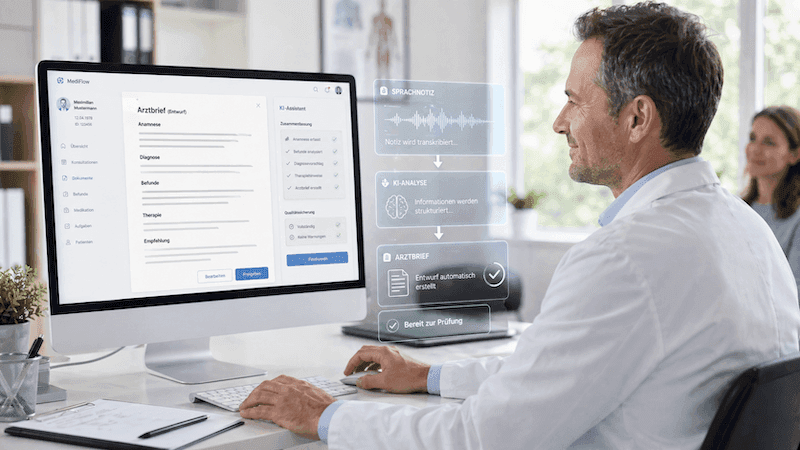
Medical correspondence is one of the biggest time-consumers in daily practice life. What used to mean two to three hours of evening work can be accomplished in minutes in 2026 using AI — provided the software is properly integrated. This guide demonstrates how automatic medical letter generation works technically, what it truly delivers, and what practices should look out for when transitionining.
There are few tasks in a medical practice that are so universally disliked as writing medical letters. They accumulate in the evening, when the practice day is actually over. They tie the doctor to the desk instead of letting them go home. And they add up: with 25-35 patients per day, that translates to an average of 60-90 minutes of additional paperwork — often longer.
With AI-supported medical letter generation, this step doesn't disappear — it is automated. Instead of dictating or typing letters after clinic hours, the generation runs in the background during the patient consultation. At the end, the doctor simply reviews and approves. What used to be the "second shift" is now a one-minute click.
How automatic medical letter generation works technically
The process is based on a chain of AI components working in unison. At its core, there are three steps:
Step 1: Real-time transcription of the conversation
While the doctor is speaking with the patient, an AI runs silently in the background. It transcribes the entire conversation into written text, recognizes specialized medical terms, and automatically distinguishes between speakers. The result: a complete transcript of the consultation without the doctor having to actively do anything.
Important: The AI is trained on medical terminology. Unlike general speech recognition, it reliably identifies specific terms like "cervical syndrome with pseudoradicular radiation" or "preoperative consultation for mitral regurgitation."
Step 2: Structuring into medical categories
From the transcript, the AI extracts the information relevant for billing and documentation and formats it into the classic sections:
Anamnesis: What did the patient describe?
Findings: What was examined and determined?
Diagnosis: What diagnosis was made?
Therapy and plan: What treatment was initiated, and what are the next steps?
This structuring happens in seconds — as soon as the conversation ends, the preliminary draft is ready.
Step 3: Generation of the medical letter
Based on the structured information, the AI creates a formal medical letter using the practice’s own template. The letterhead, salutation, structure, and sign-off follow the practice's pre-defined templates. The letter is immediately ready for dispatch — the physician only needs to approve it.
In modern systems like ClinicOS, the letter lands directly in the outbox. With a single click, it is sent via KIM message to the referring colleague or handed over to the patient as a PDF.
What automatic medical letter generation reliably delivers
After two years of productive use in private practices, clear strengths have emerged.
Completeness: The AI captures all information mentioned during the consultation — even details that the physician might not actively commit to memory. Descriptions of complaints, prior treatments, and concomitant medications are documented consistently.
Consistency: Letters always follow the same structure and use uniform terminology. This makes reading easier for the recipients (primary care physicians, specialized colleagues).
Time savings: Realistic figures from 220 working days per year indicate savings of 60-90 minutes of paperwork per day. Annually, this adds up to 220-330 hours.
Lower error rate: Typos, forgotten diagnoses, or incomplete therapeutic details become rare — because the AI accesses the full transcript, whereas a stressed physician at the end of the day has to reconstruct everything from memory.
Where the limits lie
In all honesty: not everything is perfect yet. Practices starting with automated medical letter generation should realistically assess where manual post-processing remains necessary.
Highly complex differential diagnostics: If the physician is weighing multiple hypotheses and does not voice them clearly, he or she may need to enrich the letter. The AI can only document what was actually said.
Stylistic nuances: Some physicians have a highly individual writing style — concise, ironical, or elegantly academic. AI-generated letters are usually factual and neutral. Those who value a personal touch will need to carry out quick manual edits.
Very quiet conversations or poor acoustics: If the microphone is poorly positioned or the patient speaks very softly, transcription quality suffers. A one-off investment in a high-quality desktop microphone solves this issue.
Inclusion of unvoiced information: If the physician has something in mind (e.g., a suspected diagnosis derived from physical findings but not discussed during the consultation), it will inevitably be missing from the automatically generated letter. The physician must add such points during the approval stage.
Rule of thumb: In 80-90% of cases, the AI delivers a letter that can be sent with minimal editing. In 10-20% of cases, more manual intervention is required — mostly during complex or unusual consultations.
GDPR and Data Privacy: What practices must verify
Doctor-patient conversations constitute highly sensitive data. Professional confidentiality (§ 203 StGB in Germany) and the GDPR establish clear boundaries — and not every AI solution meets these standards.
What a reputable AI solution for medical letters must provide:
Servers based in Germany or certified within the EU
Data Processing Agreement (DPA) according to Art. 28 GDPR
Encrypted transmission and storage
Clear statement: Is patient data used for model training? (The answer should be "No")
Ideally, a BSI C5 attestation or equivalent certification
What practices should pay special attention to:
Tools advertised as AI transcription tools that transmit data to the US or other third countries for processing are legally problematic following the Schrems II ruling. The practice must verify this very carefully, as the individual doctor is liable for violations. Reputable cloud-based practice management software hosted in Germany fundamentally mitigates this risk.
To be on the safe side, have the provider show you exactly where the data is processed, which subcontractors are involved, and what certifications are held.
How the transition works in daily practice
A common concern is: "My whole team will have to adapt, it will take weeks." In reality, the transition is much less complicated if structured correctly.
Phase 1 — Setup (1 week): The practice management software is configured, the letter templates are mapped to the AI system, and the microphone is positioned and calibrated in the examination room. A brief onboarding for the physician is sufficient — the AI does not require voice training like traditional dictation software.
Phase 2 — Trial phase (1-2 weeks): The physician uses the AI and carefully reviews every letter before sending. During this phase, they learn how to speak so the AI can capture everything optimally — usually, simple micro-signals such as articulating diagnosis codes or medication names more clearly are sufficient.
Phase 3 — Regular operations: After 2-3 weeks, the workflow becomes second nature. Reviewing a letter typically takes less than a minute.

Dr. Sohrab Shojaei Khatouni
Managing Director
Share on
Related Posts


Made in Germany