AI in the medical practice 2026 — what works today, what is hype, and what practices should focus on now
Highlights

Artificial intelligence in medical practices is no longer a vision of the future in 2026 — it is part of everyday practice. However, there is a world of difference between professional applications and marketing hype. This article shows which AI functions actually save time today, which are still immature, and how German medical practices can properly plan their entry.
Over the past two years, artificial intelligence has reached a point where its use in medical practices is no longer just theoretical, but has a measurable impact. Providers like ClinicOS, medatixx, or Doctolib are integrating AI functions into their practice software — and initial experience from German practices shows that AI-supported documentation can save up to two hours of administration time per doctor, per day.
But: not every AI function delivers on its promise. The market is flooded with tools that promise efficiency but fail in everyday practice due to interface issues, or are so unreliable that doctors end up spending more time correcting than they save. This guide separates what works in 2026 from what is not yet mature.
What AI can achieve in medical practices today
AI applications in medicine can be roughly divided into four areas: documentation, communication, billing, and diagnostics. Three of them are ready for daily practice in 2026. One is not yet.
1. Documentation: Real-time transcription of patient consultations
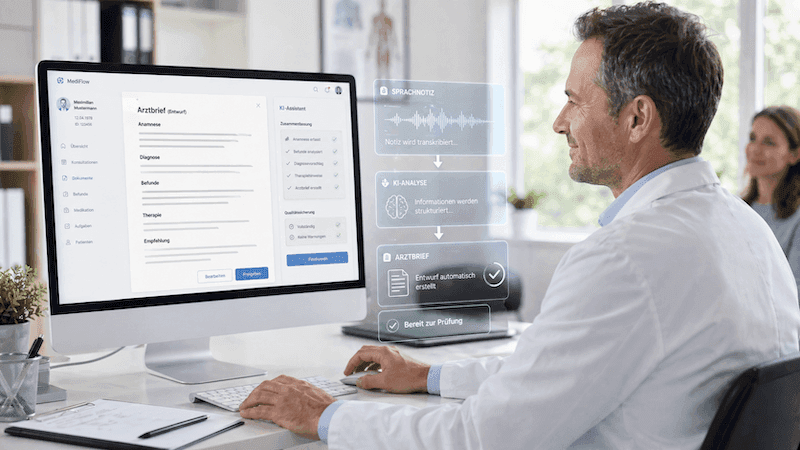
This is by far the biggest leverage. An AI medical assistant transcribes the doctor-patient conversation live, recognizes specialized medical terminology, automatically distinguishes between doctor and patient, and creates a structured documentation from it. What used to take hours with a dictation machine and subsequent typing is now finished as soon as the patient leaves.
What works:
Recognition of specialized medical language, even with regional dialects
Automatic separation of anamnesis / findings / diagnosis / therapy
Direct transfer into the patient file without copy-pasting
What is not yet reliable:
Multiple people speaking at the same time (e.g., in family consultations with children)
Very quiet speaking or loud background noise
Complex special cases in niche medical specialties
Important: AI transcription is not standard dictation software. Classic dictation solutions require the doctor to actively speak into a microphone after the consultation. With modern AI documentation, the recording runs during the actual conversation — the doctor speaks normally with the patient.
2. Automatically generating medical letters
Building on the transcription, an AI can automatically generate the medical letter. The logic: if the consultation is documented, all the information for the letter is already available — the AI simply structures it into the desired format.
In practice, this means: the doctor leaves the treatment room, the letter is already in the outbox and only needs to be checked and approved. This eliminates the "second shift" in the evening, during which doctors traditionally write their letters.
Realistic time savings: 60-90 minutes per day for an average private practice with 25-35 patients daily.
3. Phone relief through AI phone assistants
One of the most pressing burdens in German medical practices is the volume of phone calls. Current practice data from the Hamburg Doctors' Network shows: a practice receives an average of 70-80 calls per day. According to the Bertelsmann Foundation, 50-75 percent of these go unanswered in 2025. A medical assistant (MFA) spends two and a half hours a day on the phone alone — which is almost a third of a full-time position just for routine calls.
AI phone assistants answer these calls, understand natural language (no voice menu), schedule appointments directly from the online calendar, document requests in the patient file, and forward emergencies. With ClinicOS, for example, the AI phone assistant is integrated into the practice software in such a way that after an appointment is booked, the digital intake form is automatically sent — so the automation runs across multiple steps.
4. Billing suggestions by AI
Billing in private practices according to the GOÄ is complex. Many doctors bill below value because services are forgotten or multiplying factors are chosen incorrectly. AI can help here by analyzing the transcription of the patient consultation, identifying services rendered, and suggesting appropriate GOÄ codes with multiplying factors.
With the GOÄ reform in 2026, an additional factor is introduced: modern practice software can automatically map old codes to new ones so that doctors do not have to familiarize themselves with the new catalog.
Diagnostic AI: Not yet ready for a leading role
The situation is different with diagnostic AI. Tools that suggest diagnoses or recommend therapies based on symptoms are not yet a broad practical reality in 2026. The reasons are regulatory (CE certification, MDR), liability-based (who bears responsibility for a wrong recommendation?), and quality-related.
Where diagnostic AI works today: imaging (radiology, dermatology), analysis of findings, risk stratification. Where it does not work: general differential diagnosis in the consultation room.
The rule of thumb: in 2026, AI in the medical practice takes over administration — not medicine. The doctor remains responsible; the AI remains in a supporting tool role.
What practices must consider when using AI
Three points decide whether an AI project in a practice succeeds or fails.
GDPR and hosting in Germany
Patient data is subject to § 203 StGB (German professional confidentiality) and the GDPR. An AI that transcribes patient consultations processes highly sensitive data. The provider must therefore:
Operate servers in Germany or certified within the EU
Provide a Data Processing Agreement (DPA) according to Art. 28 GDPR
Ideally have a BSI C5 attestation or comparable certification
Be transparent about whether and how data is used for model training
Caution is advised with AI tools that are advertised as "GDPR-compliant" but actually transfer data to servers outside the EU. The Schrems II ruling has set clear limits here.
Interfaces to the practice software
An AI function is only as good as its integration into daily practice routines. A separate transcription app, from which results must be manually copied into the patient file, does not save time — it merely shifts the effort. Practices regularly report that missing interfaces are the most common reason for failed AI projects.
The most reliable solution: AI that is natively integrated into the practice software. Cloud-based practice management systems like ClinicOS have structural advantages here, as AI functions require cloud architecture to function effectively.
Acceptance in the practice team
The most common reason for failed AI projects in medical practices is not the technology — it is the implementation. If a new system is forced upon the practice team without training and without a say, the transition fails in the first few weeks. Medical assistants are highly sensitive to tools they misunderstand as a "replacement".
Successful practices frame AI as relief, not replacement: the AI phone assistant takes over annoying routine calls so that the staff has more time for patients at the reception desk. The AI transcription takes over the typing so that the doctor no longer has to catch up on paperwork in the evening.
What a concrete AI entry looks like
A practice that wants to start with AI today ideally proceeds in three stages:
Stage 1 — Build the foundation (immediately implementable): Online calendar, digital intake forms, automatic appointment reminders. These are not true AI functions, but they create the structural foundation. Without digital data, no AI can build on it later.
Stage 2 — Core automation (within 4-8 weeks): AI transcription, automatic medical letters, GOÄ billing suggestions. This is where the biggest time gain lies. Important: do not introduce all functions at once — but one after the other, with 2-3 weeks of adaptation time for each.
Stage 3 — External communication (from month 3): AI phone assistant, automated patient communication, recall processes. This requires that internal processes are running stably.
What it brings — and what it saves
The economic question regarding AI-supported practice software is not "How much does the software cost?", but "What does it cost us to continue working manually?". Three levers are particularly relevant here:
Staff retention: A medical assistant who spends two and a half hours a day on routine calls can use this time for tasks closer to the patient. If the AI phone and AI transcription together relieve half of an assistant's workload, staffing requirements are reduced — or existing employees can focus on higher-value tasks.
Time gain per doctor: 60-90 minutes of documentation time per day can be used either for more patients or for leaving work on time. With 220 working days per year, this corresponds to 220-330 hours — almost a second full-time position being freed up.
More complete billing: GOÄ billing suggestions based on conversation transcription identify medical services that are often overlooked in everyday practice. An increase in revenue per patient of 5-15 percent is realistic.
The effect is therefore not "software vs. no software", but "manual with staff vs. automated with software".
How ClinicOS approaches the topic
ClinicOS is cloud-based practice software with natively integrated AI. This means the AI is not a module attached as an afterthought, but part of the entire architecture. In practice, this means:
A patient books an appointment online → automatic sending of the digital intake form → structured acquisition in the patient file → self-check-in on site → AI transcription during treatment → automatic generation of the medical letter → AI suggestion for GOÄ billing. In parallel, the AI phone assistant handles incoming calls.
This automation chain only works if all components were developed to be compatible from the start. ClinicOS was created out of an actual private medical practice — so the functions were not designed on a drawing board, but from the daily needs of a real practice.
Particularly relevant for private practices: ClinicOS offers a dedicated version without statutory health insurance (GKV) functions, so private doctors do not have to navigate through overloaded menus. The GOÄ reform 2026 is automatically applied, including the mapping of previous codes to the new ones.
If you want to get an impression without obligation, you can book a free initial consultation and see ClinicOS in a live demo.
Frequently asked questions about AI in medical practices
Which AI functions are actually suitable for daily use in medical practices in 2026? Three applications are well-established: real-time transcription of patient consultations, automatic medical letter generation, and AI phone assistants. AI-supported GOÄ billing is increasingly becoming standard. Diagnostic AI is not yet ready for broad use in the consulting room.
Is AI in medical practices GDPR-compliant? Yes, provided the vendor operates servers in Germany or the EU, provides a data processing agreement, and does not use patient data for model training. Special care must be taken with tools that transfer data to third countries.
How much time does AI actually save per day? Realistic values from 2026: 60-90 minutes of documentation time per doctor, plus 2-2.5 hours of phone time per medical assistant. This allows either saving half a staff position or redirecting the existing position to more patient-focused tasks.
Is AI practice software economically viable? In most cases, yes. A medical assistant position costs several thousand euros per month including salary and social contributions. When AI functions take over part of this automated work, the software usually amortizes within a few months. Concrete figures are best determined in an individual practice analysis.
Does AI replace medical assistants? No. AI replaces repetitive, routine tasks — phone service for standard inquiries, intake forms, documentation. Medical assistants are relieved of burdens, not made obsolete. On the contrary: practices with AI support can use their staff for tasks that require human attention — patient care, triage, and complex concerns.
Can I test AI before switching? Yes. Reputable providers offer live demos and in some cases free trial phases. A trial run of 2-4 weeks is sufficient to judge whether the software fits your own practice.

Dr. Sohrab Shojaei Khatouni
Managing Director
Share on
Related Posts

Made in Germany